
First Ever Investigational ¹⁸F-CD8 PET Radiopharmaceutical Aims to Predict and Monitor Early Response to Cancer Immunotherapies
- The first patient has been scanned in a Phase I clinical trial for an investigational fluorine-18 (18F) CD8-targeted imaging radiopharmaceutical
- 18F-CD8 Positron Emission Tomography (PET) radiopharmaceutical could allow both same-day and subsequent sequential imaging, potentially facilitating earlier monitoring of a patient’s response once they start treatment and enabling physicians to select appropriate treatment sooner
- Identifying patients more likely to respond to immunotherapies could help avoid unnecessary cancer treatment and enable physicians to consider earlier alternative treatment options1
This press release features multimedia. View the full release here: https://www.businesswire.com/news/home/20230614560021/en/
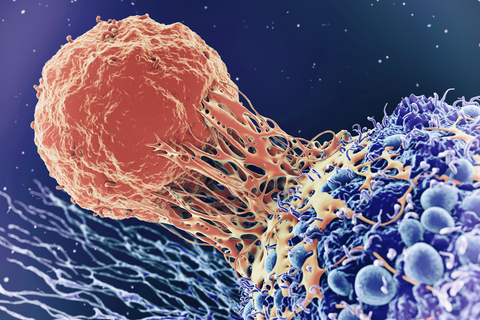
T cell (orange) interacting with cancer cell (blue) (Graphic: Business Wire)
There are around 5000 immunotherapies in development today1, almost all of which work by activating CD8+ T cells both within and outside a tumor. The clinical trial will use this investigational radiopharmaceutical to help understand if patients have CD8+ T cells in their tumors and will, therefore, be more likely to respond to immune checkpoint inhibitors, the main class of immunotherapies currently approved for use. The study will also then help identify early response to immunotherapies, using sequential whole-body imaging to monitor CD8 changes over time, enabling physicians to switch patients who are not responding to alternative treatment options sooner.
The clinical trial, initiated in
Only 20-40 percent3 of patients typically respond to immune checkpoint inhibitors. If successful, this tracer could help select patients more likely to respond to the appropriate immunotherapy. This could also avoid unnecessary treatment for those less likely to respond, or those not responding, who could be offered alternative treatment options earlier. For pharmaceutical companies and researchers, using this tracer to better understand the mechanism of action - i.e. the effect of immunotherapies on a patient’s immune response to their cancer - could, potentially, enable them to better select patients to participate in clinical trials and bring new immunotherapies to market.
Dr.
Dr.
GE HealthCare’s
About
Follow us on Facebook, LinkedIn, Twitter, and Insights for the latest news, or visit our website https://www.gehealthcare.com/ for more information.
1. Shankar L. et al. Harnessing imaging tools to guide immunotherapy trials: summary from the
2. Further information available at clinicaltrials.gov - ClinicalTrials.gov Identifier: NCT05629689 - A Study to Evaluate GEH200520/GEH200521 (18F) Safety and Tolerability When Used for PET Scans in Patients With Solid Tumour Malignancies
3. Fruhwirth, G. O., Kneilling, M., De Vries, I. J. M., Weigelin, B., Srinivas, M., & Aarntzen, E. H. (2018). The Potential of In Vivo Imaging for Optimization of Molecular and Cellular Anti-cancer Immunotherapies. Molecular Imaging and Biology, 20(5), 696–704. https://doi.org/10.1007/s11307-018-1254-3
View source version on businesswire.com: https://www.businesswire.com/news/home/20230614560021/en/
GE HealthCare Media Contact:
M +44 778 545 6999
Debbie.Leven@ge.com
Source:


